
Ernie's Alts Adventure
An evidence-based, logical primer on Alts decisions. Excerpted from the AltView's DOL comment.


Part I: An Experiment
Close your eyes and relax.
Imagine a world in which earnest, objective investor-people simply tried to do the right thing for the money entrusted to them. No litigation, no conflicts of interest.
In this world the word fiduciary might not exist. Everyone would trust everyone; no reason not to. Bringing up fiduciary concepts would confuse, like asking a fish “what is water?”
Still, it would not mean everyone would invest the same way.
Let’s imagine a focused, investor trying to navigate this world, responsible for someone else’s money.
We will call him Ernie.
Ernie knows about stocks and bonds, and the money entrusted to him is for now (passively) invested in those two things.
Below are two key questions for Ernie to answer before he does anything:
1. How do I expect different types of investments (aka asset classes, like stocks or bonds), to perform in the future?
2. Do I have skill (or can I find someone else that I decide has skills) that might get me future returns that are better than the average for any of these asset classes?
The answers will help Ernie decide:
1. Whether and how much to invest in each asset class, and
2. Whether picking individual securities (and avoiding others) within an asset class was likely to help results.
Ernie’s starting position will likely be to remain in the passively invested mix of stocks and bonds.
Why? Both asset classes have clearly demonstrated the ability to provide long-term returns in excess of inflation. Since they don’t always behave the same way, they together offer some diversification benefit.
What’s more, investing in stocks and bonds has in recent decades only gotten easier. Today’s investors get the benefit of:
· The existence of virtually free passive products[1], and
· An enormous pile of evidence showing that active investment management generally fails.[2]
Also: because the securities that comprise these asset classes are easily investible, one can gain exposure to the whole thing, if that’s your jam.[3]
But clearly, Ernie would need to do better than that.
To develop a considered view of the future, Ernie would need a rigorous, logical framework. Perhaps he’d buy a book like Expected Returns ($49.50, Amazon) by the leading authority on the topic.
For equities, Ernie’s view might look something like the table below. He wouldn’t have to do all of this himself; in this world he’d be able to find a variety of sources, all objective:[4]
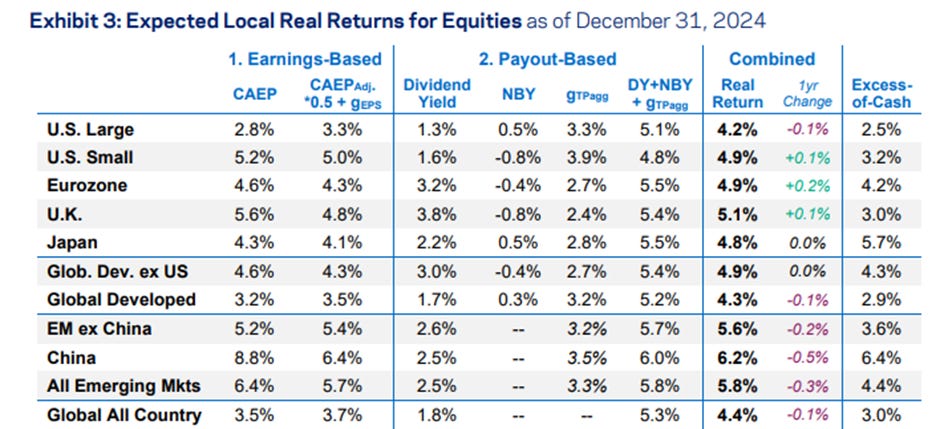
Source: AQR Capital Market Assumptions
Ernie would update these (long-term) assumptions every year, taking note of how markets evolve. The numbers (especially the differences and the changes in the differences between asset classes) would be a good prompt to act.
The wrinkle
Of course, stocks and bonds are not the only available investments in the investing universe. Enter Alternatives (or, if you like, Private Investments), include Private Equity, Private Real Estate, Venture Capital, and Hedge Funds, among others.
Ernie knows that these kinds of investments cost more, and can see that this bothers some people, including certain politicians. But Ernie knows his job: to do the best thing with the money. If someone else gets rich (or richer) because he invests with them, he does not care.
And dismissing these kinds of investments for what seem like the wrong reasons seems unsatisfying. Ernie would do his research.
Being a ‘first principles’ kind of guy, the first question Ernie would ask would NOT be (for example) “Which private equity fund will I buy.” That might come later. Instead, he’d ask, for example:
Why would I want to invest in private equity?
Then he would approach each type of Alternative Investment the same way as he did stocks and bonds; consider the underpinnings of each asset class. He would use historical returns as a starting point to form his own expectation about the future.
Ernie would note the following about various alternative asset class returns:
Private Real Estate
Ernie would see that Private Real Estate returns have notably lagged those of publicly traded real estate, despite being hard to sell (aka illiquid). This might have to do with their costs being higher. He also could see that that publicly traded real estate vehicles currently offer a notably higher return prospect than suggested by private real estate valuations.
He’d note other research has shown that private real estate investors have been in effect throwing money out the window.
For Ernie this would lead to a clear and easy conclusion: he was not going to bother with private real estate. At least not right now. If he did, he would be saying that he, the responsible decision-maker, had some special capability, or could hire someone that did.
Private Equity
Ernie reviewed (peer-reviewed, academic) research on Private Equity returns. It showed that results of the typical private equity fund showed results that were about the same as the S&P 500 from 1980-2001, during a time when the industry benefited from a gale force tailwind.
Another research report that showed middling results….
And, in the spirit of openness to all (peer-reviewed) research, yet another that showed robust performance.
What would be beyond dispute: there is still (somehow) an ongoing debate about what private equity performance has actually been.
Ernie would absorb all of this, and note that in recent years, PE performance has been decidedly poor compared with public equities (Who knows? Maybe that bodes well for the future?) and then get to work developing his own expectations.
He’d of course refer again to authoritative research on the subject; research used by the alternative investment industry’s leading credentialing organization:
and try to apply current market conditions to make his forecast.
After that, he would conclude that deciding to invest money in Private Equity (for the typical investor, which he was pretty sure was him) was not worth the bother. Why? Because on average, the prices PE firms would pay to buy stuff, combined with the interest rate paid on the debt used to buy said stuff, reveals some very challenging math.
Another thing he’d note is that while the very good funds had satisfactory results, the really bad funds were REALLY REALLY BAD; with the bottom 5% of funds actually losing money for investors, as in, not even making a dollar of profit.
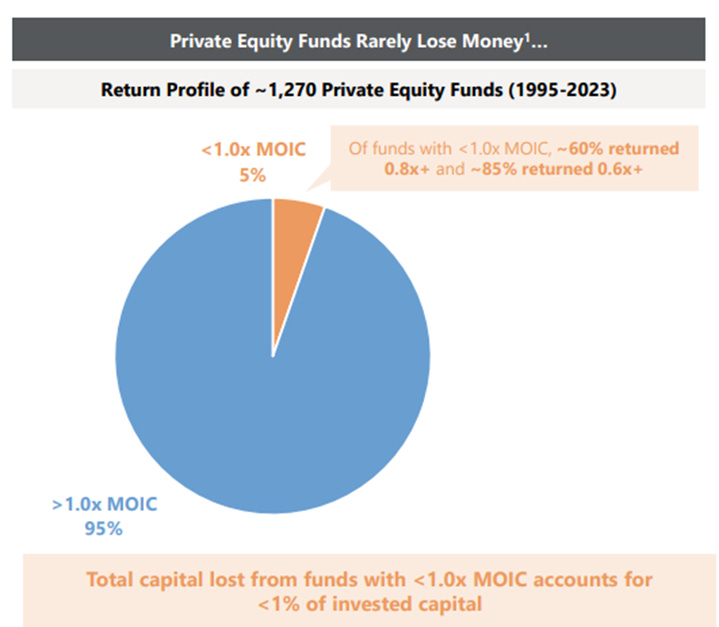
Source: Apollo
Ernie had read research on how many people that know very little think they know much more. The Dunning-Kruger something or other?
Maybe, thought Ernie, some Private Equity investors think their results are good when they aren’t?
Given that he’d just gotten started, how confident could Ernie be that he’d avoid such awful results? Or even that he could responsibly hire someone that could get good results? Hard pass on Private Equity, he decided.
Venture Capital
Ernie checked out historical returns for Venture Capital, whereby money is invested in newer, as yet unproven companies, but with large market opportunities. While some funds performed great, he could see that the (typical) historical result for a Venture Capital fund was worse than for Private Equity. The very best funds showed very good performance, while some funds really bombed.
Could Ernie know in advance which funds were going to perform better? And if he knew, would he be able to invest in those funds?
He found an authoritative book written by a fellow that seemed to know a lot about Alternatives. He wrote that the best VC firms, whose funds had historically produced the best results, didn’t take new investors.[4]
This feels the same as Private Equity, thought Ernie. Maybe someday I’ll know enough or have the right connections. I certainly will keep trying.
Private Debt
Ernie could not ignore research that shows that Private Debt returns have typically not been better than those of the Bloomberg High Yield index.
He would also recognize that the assets invested in this area have grown significantly since 2008 (in fact it was the post financial crisis reforms that triggered the growth), and fantastically over the past several years.
One academic report he read said that private debt issuers were doing so because they were not creditworthy enough to borrow from a bank. This would mean that higher returns from Private credit were not a hack, they just meant investors were taking on more risk.
He wondered (and noted that others have too) that since these investments had not endured a truly difficult period, how valuable was the data? Might the recent growth mean that future returns will be more muted? That had happened before in other asset classes. He could not be sure.
Hedge Funds
“What is a hedge fund, anyway?” …thought Ernie. Ernie had heard about some hedge funds promoting their product as being non-correlated with the stock market, while at the same time investing in a bunch of stocks. This didn’t seem to make sense.
Maybe one can’t generalize, he mused.
There was one famous hedge fund, Medallion, which showed remarkable returns. Ernie didn’t know how, truly, even after he bought and read a very good book about it.
He noted that not only had that fund not taken new investors since 2005 (similar to the best venture capital managers), but the fund was returning money to its investors. Unlike private debt, perhaps, the opportunity set was limited.
Other famous funds with good returns like Citadel seemed to do similar things.
Even if hedge funds were very ‘low risk’ (he was not sure if that was true, or what exactly was meant by ‘low risk’), would the typical return be interesting?
He read a paper that said the 15-year return for hedge funds was just 4.0% per year. Could it really be that low?
Well, thought Ernie, I cannot invest in Medallion. But 4% compared with a mix of stocks and bonds seems unhelpful. I’ll remain open to ideas, but this does not seem worth it right now.
An informed “No”
With all of this in mind, investors like Ernie might sensibly decide, based simply on expected returns (ignoring risk for the moment) that none of the aforementioned alternative investments are worth doing. If most of the investors don’t get returns that justify it, why not just stick to liquid, flexible, simple stuff?
Remember: Investors like Ernie would not be basing their decision on fear; for example fear of getting sued for a bad investment outcome— in Ernie’s world there is no suing. Rather, his decision would be grounded in evidence, logic, and humility.
In part II, Ernie rejoins the real world.
[1] Vanguard’s 500 index fund charged about .4% per annum in 1976. Today the fee is one tenth that amount! Vanguard Fee trend
[2] See also The Arithmetic of Active Management.
[3] Worried about index concentration? Fine. Invest in a low-cost, equal weighted ETF.
[4] Swenson, Pioneering Portfolio Management, page 239: “None of the top-tier partnerships currently accept new investors…new participants in the venture market must consider the return prospects of venture firms available for new-money investment.” Also: “even at the point of maximum return for venture capital, investors in plain-old large capitalization common stocks enjoyed higher returns with lower risks.” Page 238.